
Questioning Convenience
Personal Reflections on the Local Peace Economy
By Amrita Kaur
The COVID pandemic sparked a societal shift that reshaped our everyday lives. Suddenly, we no longer needed to go on our weekly grocery trips, coordinate dinners at restaurants, or visit retail stores as we once did. And why would we? The world paused, and the pause eventually turned into something that felt permanent.
In response, companies rushed to provide consumers with alternative ways of accessing household essentials. Contactless delivery, curbside pickup, and online ordering became the new normal. At the time, these methods felt necessary – solutions created for our safety given the circumstances.
Yet, I, like many others, began to take advantage of these alternatives to in-person interactions. What was supposed to be a temporary replacement started to become a permanent approach towards seeking convenience over connection.
I began to rely on these conveniences more than I’d like to admit. I ordered my coffee through an app to avoid speaking to the barista. I placed online pickup orders rather than wandering around a store to find what I needed. I formed a habit of clicking my “Amazon.com” bookmarked tab to purchase whatever I believed I needed without a second thought. Soon, I could buy anything – food, clothes, shoes – without ever leaving my home. I could even decide if I wanted those things to be a same-day drop-off or delivery to my front door. There were no limitations to what I could have. Everything had become widely accessible and endlessly convenient.
Now, almost six years later, restrictions on in-person interactions and the abundance of access and convenience should seem like a distant memory. However, the habits we formed out of necessity during the pandemic have settled and are now ingrained in our everyday behavior. We have grown accustomed to immediate convenience, with the line between wants and needs blurred and a culture of constant consumption normalized.
We have entered into a new age of hyper-consumerism, paired with the constant pursuit of convenience – the promise of saving time and effort. But at what cost? This question and its answer(s) is what I have been grappling with since beginning my internship with The Local Peace Economy (LPE) in February of this year.
As I mentioned earlier, I participated in this culture often, and it would be disingenuous to claim that I am entirely free of it. However, I began to notice the manifestation of this alarming new age while scrolling through Tiktok, a platform that has become a driving force of modern consumer culture. Specific phrases and trends kept popping up on my feed, and I felt a growing sense of frustration towards them. I regularly heard:
“How to achieve the ____ aesthetic.”
“Don’t walk – run to buy this.”
“Five items you need in your [closet, makeup bag, purse, house, car].”
My frustration forced me to confront my own behavior and perspective, now leading me to make intentional changes and a conscious effort to disengage with consumer culture. But it was not until I joined LPE and completed my first assignment – a reflection from The Local Peace Economy Workbook – that I finally had the space to articulate those thoughts of growing skepticism and discomfort. The prompt asked, “How does the war economy impact your daily life?” (p. 16). The first words that came to my mind were ‘influencer,’ ‘micro-trend,’ and ‘consumerism.’ As I wrote and reflected on my last few years on social media, particularly Tiktok, I began to find cracks in the message I was being fed: that achieving a certain standard of life depended on buying certain things.
After completing my reflection, I took a break. Out of habit, one I am actively trying to break, I opened TikTok, the very source of the messages I am working to unlearn. Still even within the app’s constant flow of consumption-driven content, a different type of video appeared on my feed. This video was of PhD student, Maalvika Bhat, discussing how convenience culture has driven society towards loneliness. She said, “Everything nowadays is subscription service…Of course if you’re not leaving your house, you’re lonelier. You’re purchasing more…It’s the system.”
It became harder and harder to ignore how deeply convenience culture and hyper-consumerism seeped into and shaped my daily life. What once felt harmless now felt destructive – a series of everyday choices distancing me from others as well as myself.
Bhat had captured what I had been trying to articulate just minutes earlier but pushed the idea further. Convenience culture and consumerism has made it so that we are not interacting with one another as we once did, slipping into patterns of avoiding social connection, trading real interactions for virtual ones, and losing our sense of community in the process. When we reduce our lives to online transactions, perfectly curated algorithms, and instant gratification, we reduce our quality of life. And if we continue down this path, we risk becoming increasingly more isolated from one another.
This sense of isolation, however, is not new. Charles Eisenstein discusses it in Sacred Economics, where he examines and critiques marketing, consumerism, and money to argue for the implementation of a new economic model – one grounded in community, sharing, and gifting – to counter the alienation brought about by our current system.
He also explores various social structures and cultures around the world, examining how different societies approach community and interdependence. This resonated with me deeply. Eisenstein describes his ex-wife’s upbringing in Taiwan, where day-care centers were unnecessary because the community cared for the children, and stopping by a neighbor’s house around dinnertime was a common occurrence (Chapter 2). It reminded me of how my family grew up in rural Punjab – and of how my parents sought to recreate this sense of shared responsibility and connection while raising me in the Bay Area.
Eisenstein’s examples offered an almost unimaginable reality compared to the world of convenience culture today. We are surrounded by subscriptions, paid services, and isolated routines, all replacing the communal forms of care we once had and commodifying our daily lives more and more. What used to be freely shared is now available to purchase. As Eisenstein says in his short film, “You have to find something that people once got for free or did for themselves or for each other, and then take it away and sell it back to them. Somehow.” This, at its core, is the mechanism that drives convenience culture, infiltrating our lives and disconnecting us from one another – our lives are now made up of consumable moments and hollow transactions.
The longer I sat with all of these ideas and insights the more I paid attention to my own habits. It became harder and harder to ignore how deeply convenience culture and hyper-consumerism seeped into and shaped my daily life. What once felt harmless now felt destructive – a series of everyday choices distancing me from others as well as myself. Trading connection for efficiency, patience for instant gratification, and community for convenience – I was no longer present.
My reflections began to intersect with my work at The Local Peace Economy, expanding ideas I was developing and reconnecting me with values I had drifted from. Through conversations with people at LPE, readings like Sacred Economics, and assignments such as my essay on Food Not Bombs, I started to recognize the aggressive intrusion of the war economy in everything, conditioning us to prioritize consumption over community and isolation over interdependence.
As I continue to unravel my relationship with consumerism and convenience culture, reconciling old habits with my new perspective, I find myself asking, “Where do I go from here? Where do we go from here?” I am aware that it is difficult to completely escape a system designed to keep us consuming – none of us can – but we can choose to be more intentional when engaging with it.
This feels especially important with the holiday season approaching. As stores lure us in with end-of-the-year sales, buying becomes automatic. Black Friday deals, algorithm-influenced gift-guides, and last-minute delivery guarantees overshadow the season of giving. But giving does not have to be transactional. Instead, we can focus on gestures that nurture connection, such as handmade gifts, acts of time and effort, or moments that foster genuine presence with each other. These small yet intentional choices remind us that our value – and what we have to offer – is not tied to material items and purchases but to the personal connection we share with our loved ones.
Looking back, I see how deeply consumerism and convenience culture influenced my life, both consciously and subconsciously. The pandemic made these habits feel necessary, but, over time, they became the default – the new normal. They gradually pulled me away from presence and community. Through my work at The Local Peace Economy, I learned to discern and criticize the systems and rhetoric that continue to push us towards consumption at our own expense.
Now, for the occasional coffee that I buy, I do not shy away from speaking to the barista (though I still mentally practice my order). I wander stores to find items myself and ask employees for help if needed. I have broken the habit of clicking my “Amazon.com” bookmarked tab for ‘easy purchasing’. These small changes and deliberate choices feel like tiny acts of resistance, where I prioritize reclaiming my intentions, relationships, and sense of self. They remind me of the life I want to live – one grounded in meaning – and that life depends on the choices I make every day. It is not about escaping consumer and convenience culture entirely but about deciding when and why we engage with it, by being intentional, informed participants in our own lives and communities.
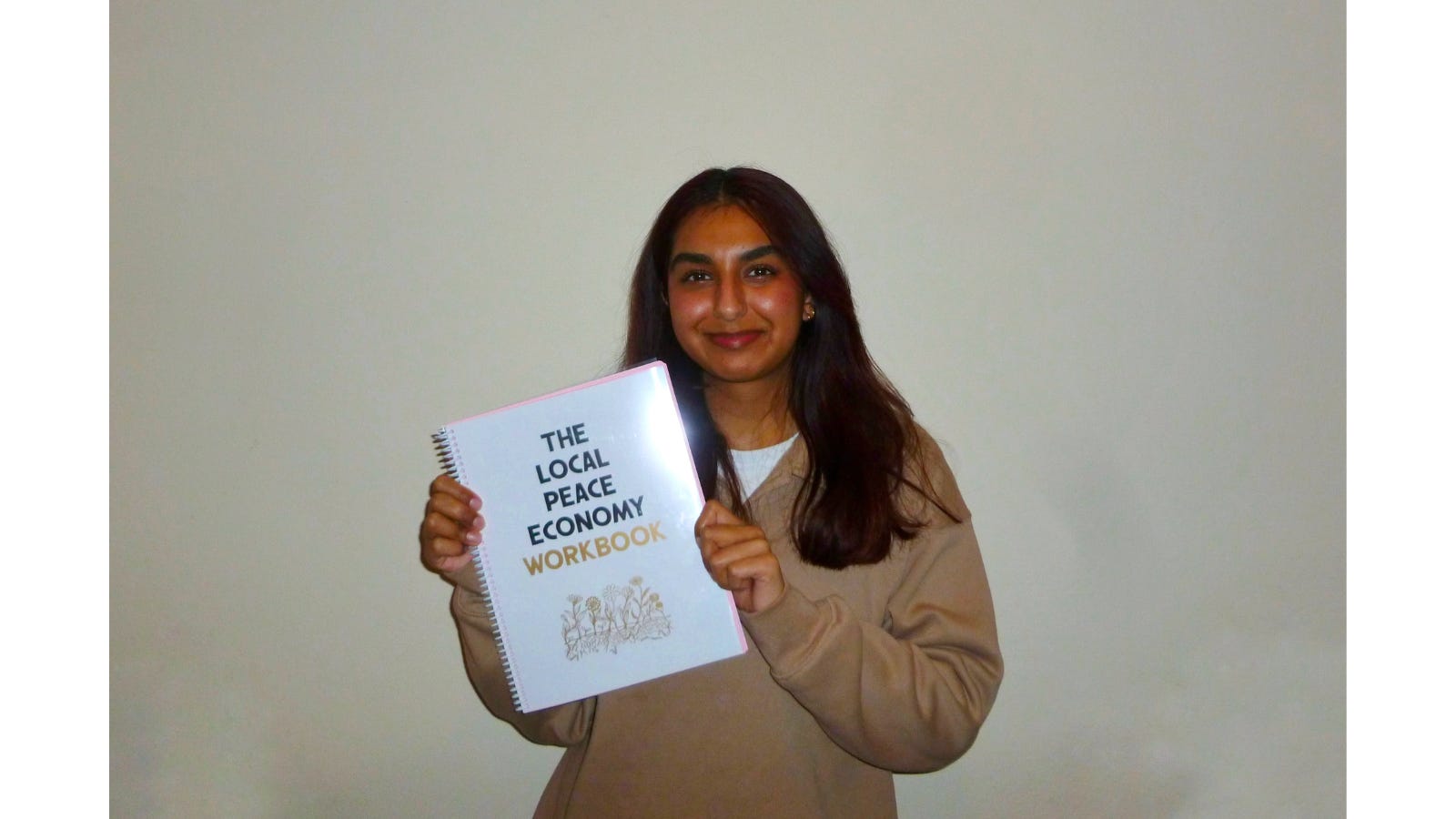
The Local Peace Economy Workbook is available purchase or free download.
Amrita Kaur is the Local Peace Economy Project Intern. She is based in the San Francisco Bay Area and attended the University of California, Riverside where she completed a Bachelor’s degree in Political Science with an emphasis in International Relations. Alongside her work with CODEPINK, she is a legal researcher for The Conservatorship Reform Project.